0
US reviews abridged
 U.S REVIEWS Abridged
Read full reviews here
The Best Old Movies on a Big Screen This Week: NYC Repertory Cinema Picks, April 6-12
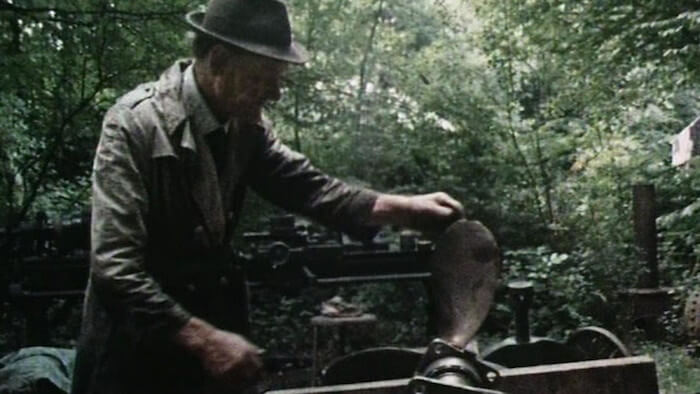
The Moon and the Sledgehammer (1971)
Directed by Philip Trevaylen
In the opening moments of The Moon and the Sledgehammer, the camera pushes aside branches and finds a clearing: the Page family residence, a few miles outside of London. Nobody’s home, so the camera has a look around, peering in for close-ups of the pianos, smithing tools and steam engine components scattered about the lawn, before the elderly Page patriarch emerges from the woods to deliver a ringmaster’s greeting. A tone of wonderment at a found object Trevelyan vérité-style but clearly pieced-together glimpses of Page—a circus clown turned self-sustaining woodsman, tinkerer and pipe organist—and his grown children, two feral gardener girls and two lost-boyish, passionately mumbling engineers, especially handy with old steam engines. Stray moments and pronouncements about sustainable lifestyles and overdependence on petroleum seem prescient—though the Page children are almost closer to the idiosyncratically socialized rural eccentrics in the phonetic dialogue scenes of a Victorian novel than today’s very in-the-know opt-outs. Ultimately this is family portrait, too specific and singular to be anything but a curio first and foremost. As a curio, though, it offers up gorgeously strange images, moments that take no set social rule, technological advance or natural relationship as a given.Mark Asch (April 9, 6:15pm at the Film Society of Lincoln Center’s “Art of the Real,” introduced by filmmaker Ben Rivers)
 Film review Critic’s Rating 4/5 STARS
The Moon and the Sledgehammer
Dir. Philip Trevelyan. 1971. N/R. 65mins. Documentary.
They seem at first naive about the ways of the world, but Trevelyan captures something poignant in their uncluttered harmony with the land. Mr. Page scoffs at these imaginative ramblings, less because he’s uninterested in the heavens than because he sees more that’s worth cherishing in his wooded oasis. He may be right—and that’s what makes this bizarre biography so unforgettable.—S. James Snyder Read full review here

| The Moon and the Sledgehammer by Andrew Schenker |
Notwithstanding the family members’ less than perfect articulation and the logical flaws of their arguments, theirs is a life lived philosophically. Taking into account the very specific parameters of Trevelyan’s project, what we get is finally of considerably more significance than what we don’t.
 ***BEST NEW OLD RELEASE OF THE WEEK***
The Moon and the Sledgehammer (Anthology Film Archives) — This lost gem from the early 1970s casts quite a hypnotizing spell as it profiles a truly eccentric English family living on an estate in the country. The Moon and the Sledgehammer is a lovely lesson in how to turn a potentially exploitative subject into something much more tender and poetic

Movies
True Escapism in The Moon and the Sledgehammer
True escapism this summer is to be found with the Page family in Philip Trevelyan‘s 1970 steam-engine idyll-doc. The seclusion is just as much an effect as a reality, and the resulting world and its garden of metaphors for the artistic pursuit have influenced outsider admirers and experimental filmmakers..