0
Fowler’s Double Steam Ploughing System
Fowler’s Double Steam Ploughing System
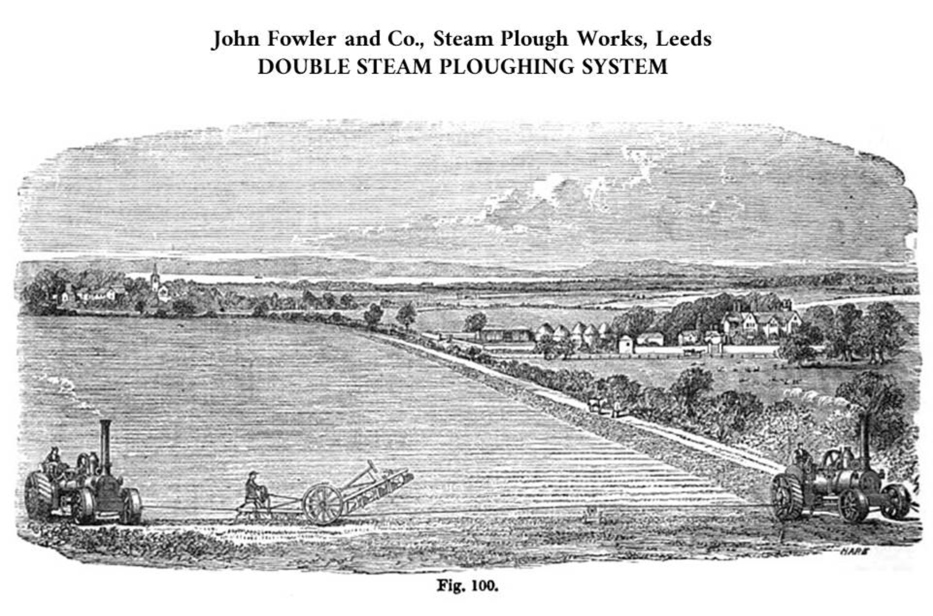
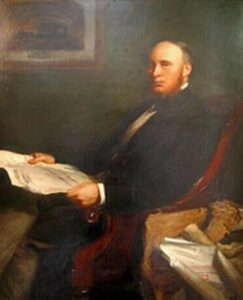
John Fowler – Plough Patent. From Patents for Inventions; Abridgments (1884) A.D. 1852, October 21.—No. 480. FOWLER, JOHN—“Machinery for draining land.” [p.37] The invention relates to machinery for forming drains in land by steam power and consists in so arranging the parts that “the boiler, steam-engine, and coulter or cutter are all combined and go together, the steam-engine giving motion to a drum to wind on a wire rope, and thus to move itself up to an anchor or fixed point on the land.” The machine is furnished with an upright coulter and a shoe or share for [p.38] forming the drain and drawing a continuous series of drain tiles into it, like the apparatus described in Nos. 12,989, A.D. 1850, and 13,285, A.D. 1850. A steam-engine and boiler are fixed upon the carriage, which travels on four broad wheels, and carries at its front end a large drum. On the crank shaft driven from the steam cylinder are four eccentrics, and these, by suitable connecting rods acting on a ratchet wheel on the drum shaft, impart a “step-by-step” motion thereto. The end of a wire rope is conducted from the drum to the opposite side of the field, passed round a pulley attached to an anchor or holdfast, and then brought back and fastened to the frame of the carriage; so that on the drum being put in motion by the engine, it winds up the rope, and draws the machine towards the anchor. If greater speed be required, the pulley is dispensed with, and the end of the rope is secured to the anchor. When the machine has arrived at the anchor, the power of the engine is applied to turn a small drum, round which is passed a rope from an anchor situated at the place where the machine is to recommence its action; and as the carriage is thus drawn back to the opposite side of the field, the large drum pays out or delivers its rope in readiness for the next forward movement of the machine. The patentee states that for some purposes he prefers to perform the operation of delivering or paying out the rope from the large drum by turning the front wheels by any convenient gearing worked by the engine, so that the bite of such wheels upon the land shall act to drive the machine in the requisite direction. This arrangement also serves for the transport of the machine from place to place along common roads. Text from Commissioners of Patents for Inventions, Patents for Inventions; Abridgments of Specifications Relating to Agriculture, Division III, Agricultural and Traction Engines, A.D. 1618-1866, (1884), 37-38. By 1860 he had entered into an agreement with Kitson and Hewitson of Hunslet, Leeds, for the manufacture of his steam ploughs. Fowler’s Steam Plough Works were built on neighbouring land at Hunslet and employed around 100 men at the time. By 1863 John Fowler & Co had been established and its work force had increased to 400. Tragically, John Fowler’s unrelenting work ethic was to be his downfall. Overworked, he was suffering from exhaustion. His doctor recommended a break from work and plenty of fresh air. Fowler took to hunting but had an accident and injured his arm. This led to tetanus. He died at just 38, years before his company would reach its zenith.
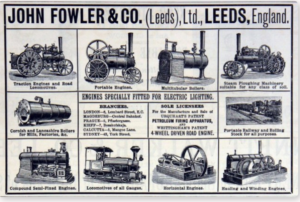
However, the foundation he laid and the innovative culture he fostered were so strong that his partners, Robert Eddison and David Greig, continued his work, building the company into a global powerhouse under his name. In Fowler’s obituary, which appeared in the Gentleman’s Magazine, they stated that upwards of 300 of Mr. Fowler’s apparatus are at work in various parts of the United Kingdom and many more around the world. For more than twelve months the number of engines sent out from Mr. Fowler’s manufactory at Leeds has been at the rate of about six per week. This legendary engineering firm John Fowler & Co. (Leeds) Ltd. was acquired by Marshall, Sons & Co. of Gainsborough in 1947, effectively ending its run as an independent company. While the Fowler name continued to be used on certain products for a few more decades, the original powerhouse of steam and diesel innovation was absorbed into a larger entity, with production at its famous Hunslet works eventually ceasing. It is to Fowler’s credit that hundreds of Fowler engines—from ploughing engines and road locomotives to steam rollers and tractors—have been lovingly preserved and restored by dedicated individuals and heritage groups worldwide. They are the stars of steam fairs and vintage rallies across the UK, Australia, New Zealand, and beyond. We will never know what other advances Fowler could have made had his life not been tragically cut short but his legacy lives on. Today he is rightly hailed as an engineering genius.
Next chapter - The Fowler engine in the film →